
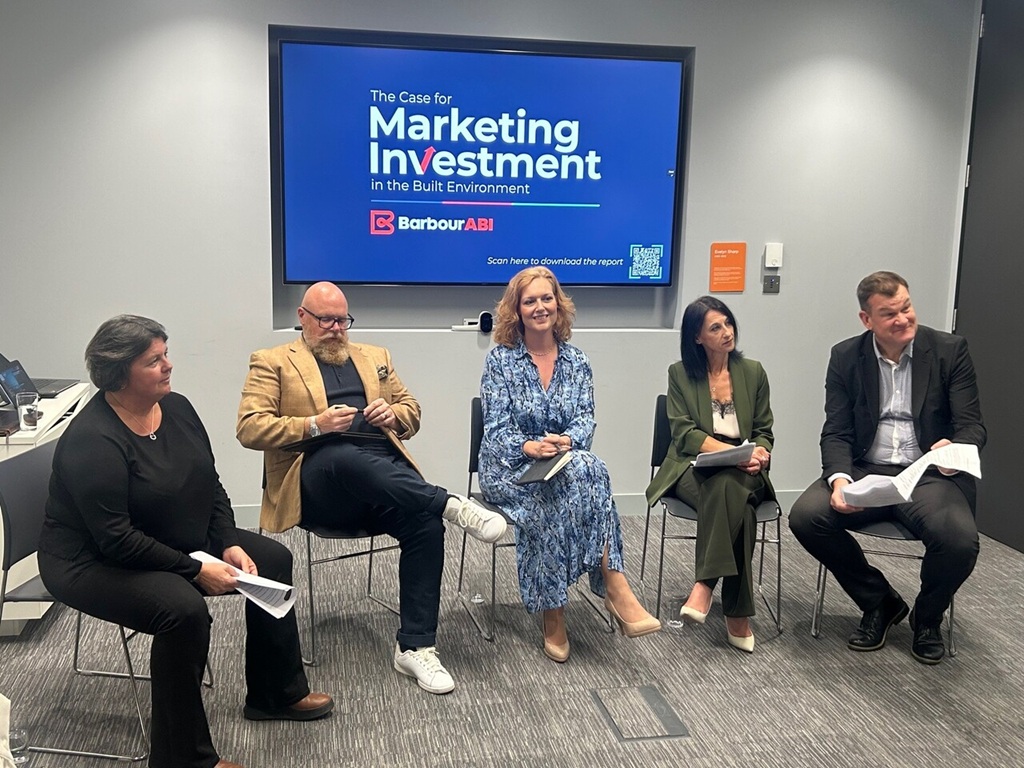
Panelists (from left to right): Amanda Long, CCPi; Stuart Devoil, James Latham; Helen Gawor, Building Strategy Ltd; Lucia Di Stazio, Encon; and Andrew Geldard, Willmott Dixon
David Pead, CBE Marketing Network
“As an industry we solve problems – but we haven’t solved the problem of marketing,” said Amanda Long, opening a panel discussion on The Case for Marketing Investment in the Built Environment.
The event coincided with the publication of a new report by Barbour ABI, produced in partnership with the C&BE Network and Futurebuild, which examines how marketing is currently funded, valued, and practised across the sector.
“The survey the report was built on found that just one in ten construction marketers think we’re better than other sectors at marketing – and that’s a massive worry,” said Long. “If we don’t believe in our own ability to market effectively, how can we expect to shift public perceptions of our industry?”
Helen Gawor agreed: “We need marketing leaders to stand up and be counted. In fact, we need a Clarkson’s Farm for construction – something that makes the skills and challenges we face every day visible and engaging.”
All panellists agreed that marketing teams must be closely aligned with the strategic direction of their business.
“It’s so important to be at the cutting edge of the business,” said Andrew Geldard. “Too often there’s a disconnect between marketing and what happens in the boardroom. A Chief Executive isn’t interested in tweets or likes – they want to know if marketing can move the dial. What are you doing to help open new sectors or drive growth? Stick close to the senior team and don’t work in a bubble.”
Stuart Devoil, one of this year’s CMA Awards judges, noted a similar issue in the awards entries: “Without giving anything away, some categories specifically ask how the marketing strategy links to the company strategy – and many don’t even mention it.”
Lucia Di Stazio said marketing delivers enormous value when aligned with business strategy, but credibility must first be earned: “So much of the marketing team’s work is reactive – ‘quick, get that post out!’ But we need to think long-term and more strategically about what really resonates with our audience. That’s why market research is fundamental. How can you go to market without understanding it? There’s a lot of noise out there, and you need to know what matters.”
The report findings echo this point, showing that businesses where leadership sees marketing as strategic consistently invest more in teams, training, and brand building. Yet across construction, too few marketers have a seat at the top table.
Other sectors are far more likely to have a CMO on the board. In construction, where around 90% of businesses are SMEs, it often falls to Tier 1 contractors to set the tone – telling the broader story of their supply chain and supporting social value delivery.
Emerging technology could help close the gap. AI tools can already summarise legislation, draft business plans, or support small firms with admin – freeing up marketers for higher-value work.
But, as Devoil cautioned, these tools also demand new skills: “For the first time, in the 18–36 age group, AI has overtaken Google as the place people turn for information. That means we have to make sure our content is optimised for chatbots as well as search engines.”
- The full report, The Case for Marketing Investment in the Built Environment, explores these themes in depth — from brand spend and leadership support to technology, training and culture — and is available to download on the Barbour ABI website.