
Katie Nelson, Cartwright
Built environment event season is no longer a few moments in the calendar – it’s a year-round cycle of investment forums, regeneration conferences, housing summits, regional property events, awards, roundtables and exhibitions.
With that comes one familiar question for marketing teams: should we sponsor?
It’s not an unreasonable question. Sponsorship can be hugely valuable and can give a business profile, a presence in the room and a focal point for meetings, content and relationship building.
But it shouldn’t be the first question. The better starting point is: what do we need this event to do for us?
That distinction matters. A logo, a stand, a speaking slot or a drinks reception might all create visibility, but visibility by itself is rarely enough – the real value comes from what that visibility helps you unlock.
Are you trying to build stronger relationships with local authorities? Open conversations with developers, investors or contractors? Launch a new point of view? Support recruitment? Reposition the business? Gather market intelligence? Move live opportunities forward?
Regardless of your objectives – opening conversations, building relationships, launching a product or service – your approach needs to be tailored.
A business trying to influence public sector relationships may get more value from a tightly chaired private roundtable than a busy reception. A consultancy with a complex message may need a clear pre-event thought leadership campaign more than it needs a bigger stand. A challenger brand may benefit from a smaller, sharper format that gives the right people a reason to engage properly.
There’s no magic wand. But there is a clear pattern: the strongest event activity starts with strategy, not simply spend.
Sponsorship buys space, strategy creates meaning
Built environment events are crowded spaces. That is part of their inherent strength – they bring together the people who fund, innovate, plan, design, build, manage and influence the places around us.
But it also means they are noisy. Everyone has something to say, a panel, a LinkedIn campaign – all with the same aim of achieving cut through in an increasingly loud battleground for attention.
But in that environment, the challenge is not simply being seen – it is being remembered for something useful. That means marketers need to think beyond the sponsorship package itself and ask what the activity will actually contribute to the wider conversation.
The badge matters. But what sits behind it matters more.
All it takes is One Big Idea
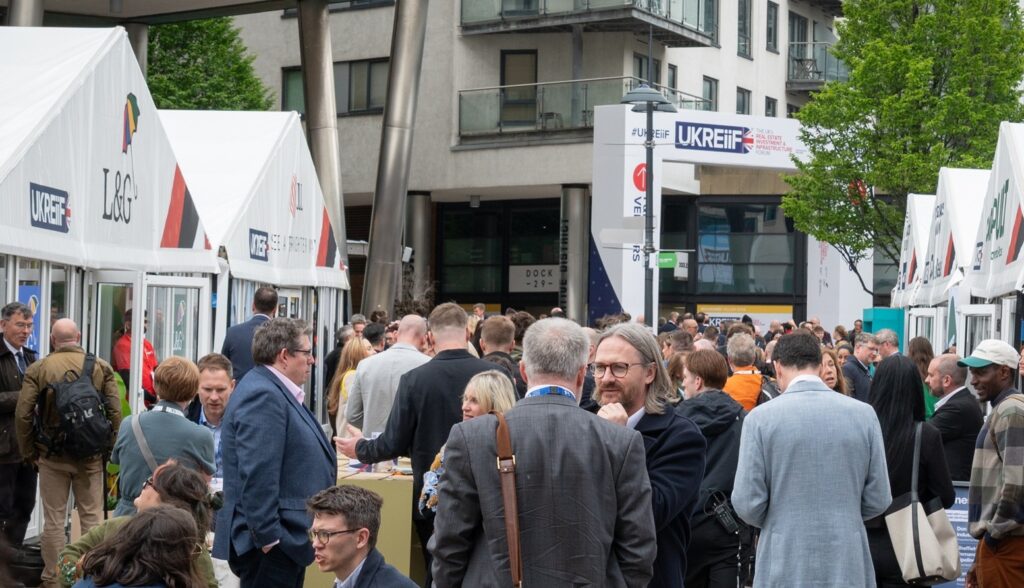
UKREiiF is a useful example because it shows both the scale of the opportunity and the risk of treating a major event as a few days of profile.
More than 16,800 people attended UKREiiF 2026, including nearly 2,000 public sector and government delegates and almost 500 people from university and student backgrounds.
For marketers, that scale is exciting, but equally intimidating with the competition for attention becoming super intense. Packed diaries, fringe events, regional pavilions, panel sessions and networking drinks all create opportunities, but they also create clutter.
It’s why having a strategy on what you want to get out of such an event has to be the starting point. Without that direction, the risk is that any spend invested creates no impact or return. And believe it or not, in such an environment, an extremely effective event activity is not just broadcast – it’s to listen.
As part of Cartwright’s official storytelling partnership with UKREiiF, we created One Big Idea to ask people across the built environment a simple question: what is your one idea that could make the property, construction and investment sectors work better?
Skills, inclusion and social value came through as the most prominent theme. Digital, AI, planning, procurement, finance, retrofit, circularity and placemaking were all strongly represented too. But perhaps the most useful finding was how many of the ideas connected with each other.
One person identified a barrier, another suggested a tool. Someone else imagined a delivery model, another focused on how it could scale. So, One Big Idea didn’t just identify innovations or better ways of doing things. It’s created connections across the sector to bring those ideas a step closer to delivery – all working towards creating a real-life impact.
Exercises like this are a way to understand what the sector is wrestling with, where the shared frustrations sit and how conversations can move towards action.
Rethink the format, not just the footprint
The other clear shift is that audiences are changing.
Event industry research suggests connection has overtaken content as the number one reason people attend business events. Static keynotes and traditional panels are losing ground to smaller, more interactive formats, and average session lengths have shortened to around 35 minutes.
And that passes the eye test as well – most of us have sat through the version of a panel that does not work, whether that’s through poor moderation, parrot-like responses or simply a lack of audience engagement.
Now, this doesn’t mean traditional panels are dead – but they do have to work harder and smarter and, ultimately, evolve with their audiences.
If the aim is connection, influence and useful insight, we need fewer sessions that feel like broadcast and more that feel like contribution.
Shorter conversations. Better questions. Clearer outputs. More audience participation. A good test is simple: would someone take notes or tell their colleague what was discussed? If the answer is no, the format probably needs rethinking.
An evolving picture
There is also a generational point that built environment marketers should not ignore.
Only 13.6% of Gen Z attendees register for events more than four weeks in advance, with the rest driven by impulse, peer influence and social media discovery.
That matters for a sector that talks constantly about future talent, skills gaps and widening the pipeline, because if younger attendees are discovering events later and through different channels, event marketing cannot rely only on longer-tail email campaigns, senior stakeholder lists and formal invitations.
It needs content that travels across different channels and gives a clear and personal reason to engage.
This is not about chasing trends for the sake of it. It’s about recognising that the next generation of built environment professionals may not engage with events in the same way as the people currently approving the budgets.
All of which begs the question: are you designing your activity for the audience you already know, or the audience you say you want to reach? And how does this change how you measure impact and return from any expenditure?
One of the biggest missed opportunities is treating the event itself as the conclusion – the team turns up, the meetings happen, the stand comes down.
A few LinkedIn posts go out, and everyone gets back to their day job.
But the strongest event strategies see the day itself as the middle of the campaign, not the end. It needs to flow like a classic narrative arc – build the story before the event, capture the insight during the event, turn it into something useful afterwards.
This is where marketers can prove value beyond impressions. Has the event helped you build trust, sharpen your message, deepen relationships, act as a springboard and create momentum?
The industry is moving from a season of conversation towards delivery – events have to reflect that shift too.
The sponsorship conundrum
Sponsorship can still play a powerful role in all of these tactics, but the true value is tied to a clear point of view, a defined audience, a useful format and a follow-up plan that carries the conversation forward.
What comes next should not simply be another call for bigger stands, busier panels or louder branding. It should be a call to connect things better: people, ideas, evidence, stories and action.
The built environment is an industry built on relationships, and success often depends on connecting with people on a human level. That means moving past jargon and telling clearer, more relatable stories about why your work matters in real terms, not just monetary statistics.
The best value from any event is not always found in the biggest presence – but it always starts with a great question.