
Kate Sugarman, Ridgemount
I am reading a lot of posts on AI at the moment, almost every other piece of content I see these days is on AI and they are all polarising. It’s either “stop the AI slop and bring back humans” – or its “AI is so good that it is coming for all of our jobs”. I think the real gold is in the middle.
The slop is real, but it isn’t all AI’s fault. Nine times out of ten, it’s the fault of the person at the keyboard who doesn’t understand what they’re doing, gets a bad result, and decides the tool is the problem rather than the operator. We don’t blame the camera for a bad photo and yet we’ve somehow decided AI is different.
For years the hardest part of my job wasn’t having ideas, It was executing anything more complex than my skillset would allow. I’d get an idea and then I’d have to go and brief a designer, or a developer, or some combination of people I didn’t have to hand. Often, with an idea, you don’t necessarily know specifically what you want, which makes briefing someone very difficult. When it comes to briefing, you need to know exactly what you want and you need to be able to articulate it to the person that you’re talking to. At that point, the costs get larger and larger, and somewhere between the idea and the invoice, the idea can die because it’s become too expensive to be worth doing. AI has taken away this barrier to entry for a lot of things.
That’s mostly gone now. If I read a dense piece of text and I start thinking about how to make it more interesting, there’s a tool that will turn it into a podcast. If I’ve got a piece of government policy that matters to a client but reads like it was written to be ignored, I can turn it into something a person would actually want to read. I read a study recently that said something like seventy per cent of people can tell when they’re looking at AI content, and I thought I’d quite like to test that, so I built a little interactive game to see if it held up. No design skill, no code, an afternoon. And if it had gone nowhere it would have cost me nothing, which is sort of the whole point.
This does, in many ways, devalue things. If a social asset only takes a few minutes to make as opposed to half a day, then where exactly is the value in having a human spend that time on it? When a client is watching their budget, then “craft” is not always the answer that they’re looking for as to why you should have a human spend their time doing it. I think the real answer to this comes in when you can start testing these sorts of things:
- creating an asset and written text using AI
- creating a human version
- creating a hybrid and testing which one has the most traction
We did look at this a couple of years ago, but the results were a bit more murky. I don’t think that people were quite as used to seeing AI and therefore weren’t as easily able to identify it as they are now. I think the bigger question is the one that keeps me awake at night. What does an agency like Ridgemount look like in a world where AI has quietly taken a lot of the skills that we spent years honing and getting better at? I don’t really have a definitive answer to that. Anyone who tells you any different is trying to sell you something.
So of course people are defensive. I’m anxious about it too. Jobs are going across the board, plenty of big companies are quite openly looking at AI as a way to need fewer human beings, and when it’s your livelihood on the table it’s very hard to look at any of it fairly. A lot of the slop talk is really just that fear talking. There’s a sort of quiet hope underneath it that everyone will have a play, decide it isn’t any good, and we’ll all get a big reset back to how things were. I don’t think that reset is coming.
But here’s the part that genuinely excites me, and it’s the part nobody anxious wants to hear.
I’m someone who has the ideas and almost none of the skill to bring them to life, and AI lets me get further than I could before. Fine. But that’s the floor, not the ceiling. What I really wonder about is what happens when you put these tools in the hands of the people who do have the skill. The brilliant designers, the people who can actually make video, the programmers who’ve spent years getting good at it. When you take that kind of embedded, hard-won brilliance and add AI to make it better, you don’t get slop. You get people doing their best work, faster, and reaching further than they ever could on their own. If anything the gap between them and the rest of us only gets wider.
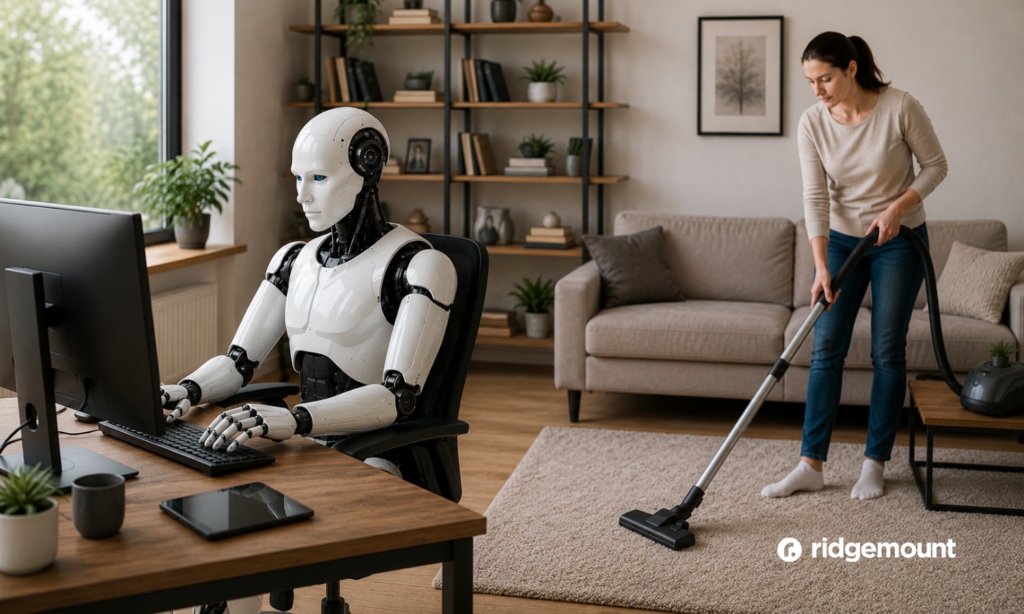
When AI first started entering the mainstream, people kept reaching for AI to do the stuff that needs a human soul in it. Art. Music. Writing that’s meant to move you. And I remember thinking, that’s exactly backwards. The old promise was that the robots would take the boring jobs so we’d have more time for the good stuff. Do my hoovering. Do my washing. Do not do my drawing, art, photography and writing.
Marketing is just the next version of that same trade. What I want is an AI that pulls together a genuinely good report out of the numbers I feed it, so I get my time back for the part of the job that’s actually mine. The ideas. The strategy. The campaigns that get a client a real return. The posts that make someone stop and respond. I do not want it doing the creative thinking. That isn’t the boring bit. That’s the whole point.
The people who’ll be fine in two years aren’t the ones hiding from this. And they’re not the ones quietly letting it think for them either. They’re the ones who keep hold of the soul and hand the machine the heavy, boring weight it was actually built to carry.
I know which one I’m trying to be.