
David Pead, CBE Marketing Network
“You don’t need to measure whether marketing happened,” said Alex Swann. “It’s fairly irrelevant. What did it do? Did it change a buying decision? Did it move people on the customer journey?”
It was one of the sharper lines from the second session curated by the CBE Marketing Network at UK Construction Week, which looked at agency relationships with the client side.
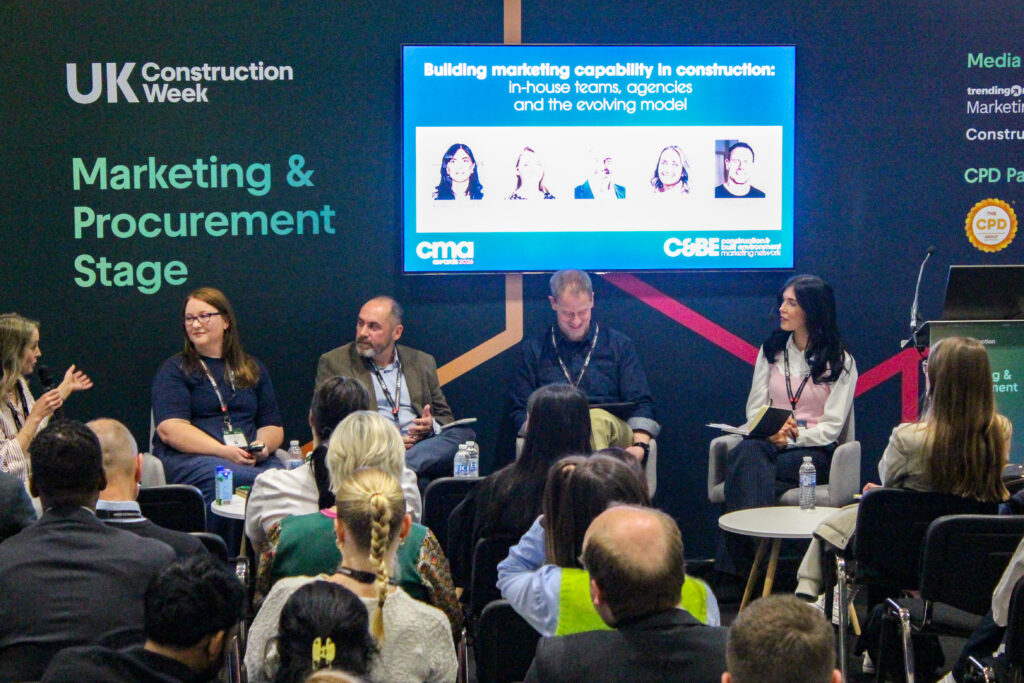
The discussion was focused on how marketing capability is being reshaped at a time when in-house teams are under pressure, agencies are being asked to provide more strategic value, and AI is changing what can be delivered, how quickly, and by whom.
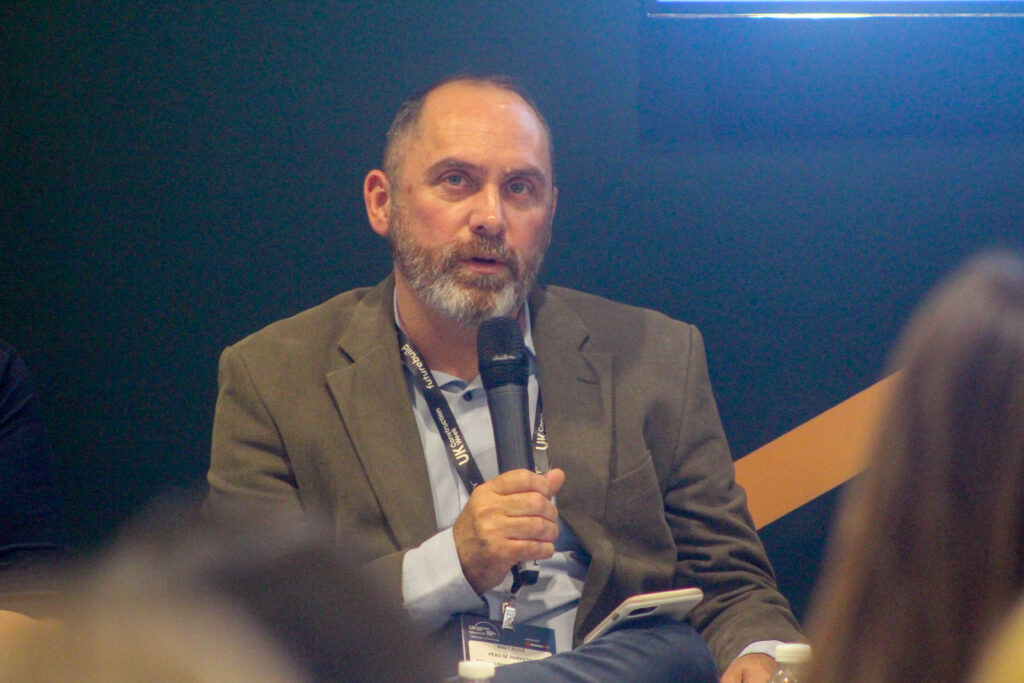
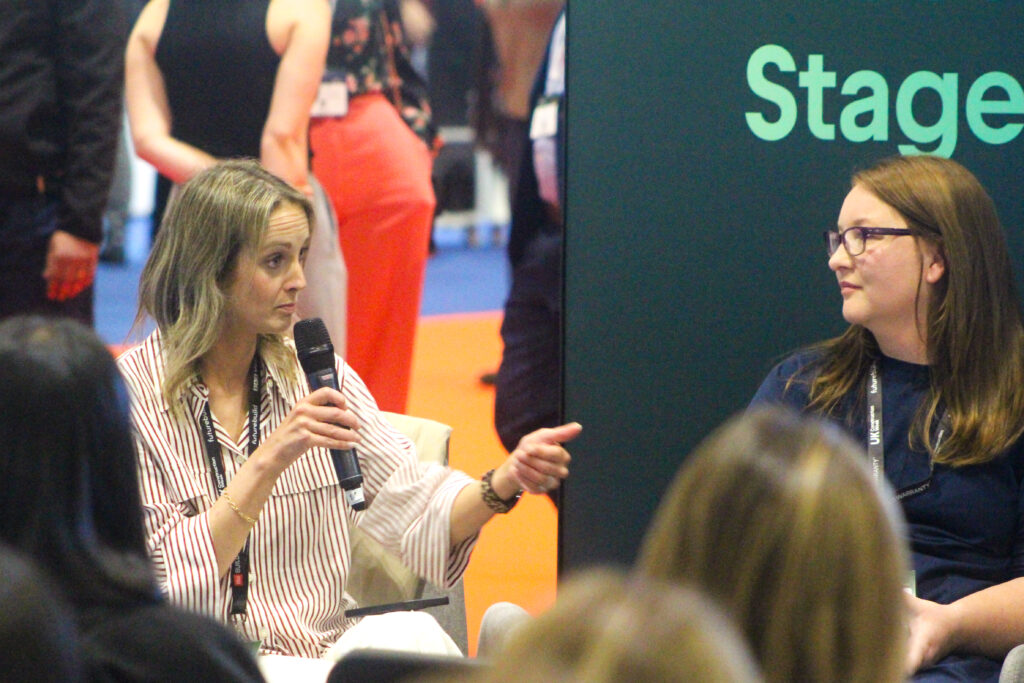
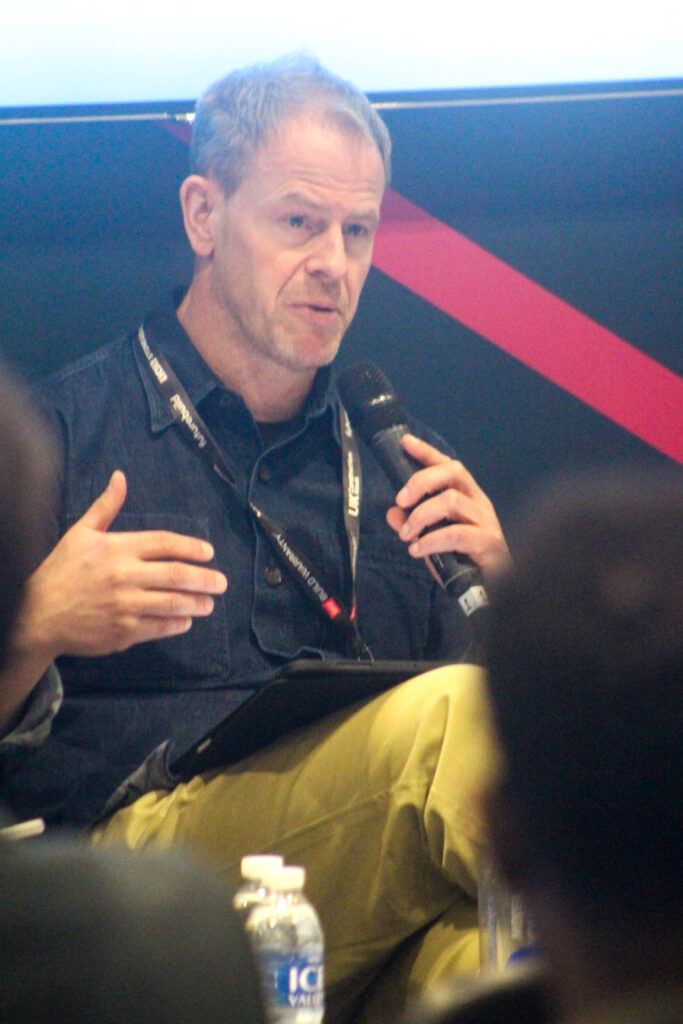
Chaired by Elizabeth (Libby) Zbaraska, founder of Eazy Communications, the session entitled Building marketing capability in construction: in-house teams, agencies and the evolving model brought together Helen Cooper, Head of Marketing at Altecnic, Andy Mudie, Head of Marketing UK & Ireland at Etex Building Performance, Cerys Reynolds, Business Director, B2B & Corporate at Tangerine, and Alex Swann, founding partner at Lesniak Swann.
Stop trying to do everything
Libby opened by asking the panel what construction marketing teams should stop doing immediately.
“The very first thing I’ll say is stop assuming that the audience is one audience,” said Andy. Specifiers cannot be treated as a single group. Architects, main contractors, clients and other decision-makers all have different priorities, routes into information and reasons to engage.
“You have to break it down,” he said. “You can’t do the same comms to the same people. You have to segment it well.”
Helen was concerned that many teams, particularly smaller in-house teams in construction, are being asked to do too much with too little clarity.
“The one thing that marketing teams need to stop doing is trying to do everything,” she said. “Be targeted, spend more time thinking than doing, and it’ll show in the commercial success of anything that you’re working on.”
For Cerys, the issue was how B2B itself is understood. Her challenge to the sector was to “stop being B2B in strategy and comms” in the narrow, mechanical sense.
The buying journey may be complex, technical and high-stakes, but the people making those decisions are still people. “It’s creating that emotional connection with your audience that’s really important,” she said. “How do you do that? You treat them like human beings.”
What AI changes, and what it does not
AI was a constant theme throughout the discussion and is already part of agency workflows, according to Alex. “There are a lot of agencies that are quietly getting on and doing stuff,” he said. “They just don’t talk about it because they think other things are more important.”
Helen argued that AI should not automatically mean agencies charge less or devalue what they provide. If AI creates efficiency, she suggested, the value should move elsewhere: into planning, research, better conversations, better briefs and better thinking.
“Surely we don’t need to start charging less and devaluing what agencies deliver,” she said, “but start using that money more effectively elsewhere.”
Andy described how Etex is already using closed AI systems internally to support technically accurate customer responses. That, he said, changes expectations of agencies too.
“We’re using it internally for efficiency, for clarity, and getting things right,” he said. “We’re sort of expecting that from agencies as well now.”
Cerys placed the agency role in a broader strategic context. AI is changing how brands are found, how they appear in search and how communication strategies need to be built. Agencies, she argued, should help clients understand that landscape and respond with confidence.
“What an agency should be able to do is help clients build comms strategies around AI,” she said.
Agility, or something else?
Clients increasingly want agencies to move quickly, respond to changing priorities and adapt to internal demands. But Alex questioned whether “agility” is always the right word.
“If someone asks you for agility, you first of all need to translate that,” he said. “Most of the time they mean, can you do it faster or cheaper?”
What clients really need from agencies is not simply speed, but less friction. Agencies should absorb complexity, not pass it back.
“There’s a line that I use sometimes: slow is smooth and smooth is fast,” he said. “Sometimes people are asking for things quickly, and then the agency’s role is to actually step back and say, we need to look at the brief here.”
Andy agreed that good work starts with clarity. From the client side, that means understanding why something is being done, what the value proposition is, and what the brief needs to achieve before asking an agency to respond at pace.
“You’ve got to know why we’re doing it,” he said. “That whole direction of why you’re doing it is absolutely paramount.”
Cerys said that agility is not only something clients ask of agencies. Agencies need it from clients too. “You’ve got to have a partnership that is built on trust,” she said. “You both need to be able to trust each other to push and pull quite quickly.”
The agency as challenger
One of the clearest themes was that agencies can no longer justify their role simply by producing more content, more quickly. The agency’s value lies increasingly in its ability to challenge.
“Our job is to disagree,” said Alex. “We need to sit in front of the client and say, I disagree with you. I think you’re wrong. I think this is a better way to do it.” That does not mean being difficult for its own sake. It means bringing evidence, external perspective and sector understanding to the conversation.
“The best client relationships we have, the ones that get the most out of us, actually employ us because we disagree,” he said.
Andy made a similar point from the client side. The old idea of using agencies simply for creative output is fading. What matters now is whether an agency can help a brand become visible, relevant and understood in its market.
“It really now is a case of how we’re recognised, how the brand is picked up within our space,” he said.
Helen said that the most valuable agencies are those that understand the pressures clients themselves are navigating. “The agencies that are going to be able to support me best at Altecnic are the ones that understand my problems the best,” she said. “The ones that can help me find solutions to the challenges that AI is throwing at brands at the moment.”
Cerys argued that the model is also shifting towards “earned-first” thinking. “Audiences are expecting brands to show up consistently with authenticity,” she said. Earned media and PR strategy need to play a much more central role as AI search changes how brands gain visibility.
Where relationships break down
Helen believes that the strongest agency relationships are built on regular contact, honesty and forward planning, even when there is not an immediate project to hand over. “The ones that have been successful relationships are the ones that keep in touch with us, whether we have something to give them or not,” she said.
Where relationships have not worked, she said, the causes have often been familiar: poor briefs, weak feedback loops, or the feeling that the client has not been listened to.
Cerys identified two common fault lines: lack of alignment and lack of trust. If the client and agency are not clear at the outset about business goals, success measures, KPIs and internal reporting, they can quickly start pulling in different directions.
“A good agency relationship is built on solid consultancy,” she said. “What you do need your agency to do is challenge you and take you on that journey.”
Andy said the best relationships are built across teams, not just between one client contact and one agency lead. Agencies need access to the wider in-house team if they are to understand the business properly.
Judgment still matters
Towards the end of the session, Libby asked where agencies would offer the most value over the next two years.
Helen said it would be those areas where AI cannot replace human nuance, particularly crisis communications. Cerys chose trust. Andy chose knowledge and experience, especially given the level of regulatory change facing construction.
Alex brought those ideas together in one word: judgment.
“What you’re actually buying and paying the extra money for is that judgment,” he said.